
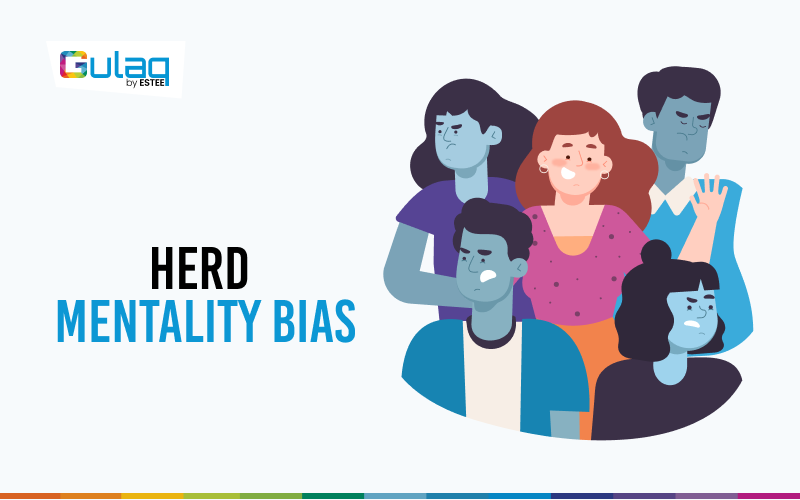
Herd Mentality Bias
Which one do you pick?
Most people in this scenario would choose the busier
restaurant. While some might be rationally concluding that more crowd means
better food (which may or may not be true), many are simply following the
crowd.
This behavior is a classic example of “Herd Mentality
Bias.” Humans tend to think and act in herds. We often follow the crowd and do
what others are doing, even when it might not make sense to them individually.
French philosopher and writer Albert Camus said
it best, “People would rather be wrong together than be right alone.”
While one might think that one should avoid
falling prey to this bias all the time, one can actually use this bias to his
advantage.
For instance, when deciding on a movie to watch,
I always make a point to check out the IMDB reviews (especially the negative
ones) and evaluate whether the movie is worth my time or not. While the good
reviews don’t guarantee that the movie will be to my liking (e.g., La La Land),
it certainly increases the probability.
In situations when we have limited information
or expertise, following the majority can lead to better outcomes, as the
collective knowledge of a group often outweighs that of any single person.
However, in some instances, it can also lead individuals to make irrational
decisions (discussed later in the article).
Why do we think & act in herds?
A survey conducted by the CFA Institute found that herd
mentality bias is the most common bias that affects investment decisions.<
This tendency of humans to think and act in
herds has an evolutionary reason behind it. Before we got civilized, we used to
live in tribes as hunters & gatherers for hundreds & thousands of
years. And in the wild, being excluded from the tribe meant certain and
imminent death. Therefore, people evolutionarily got hard-wired to stick to the
tribe and avoid social exclusion at all costs.
Although times have changed, we still retain our
animalistic urge to avoid social exclusion at all costs. This urge is so strong
that a study done by Eisenberger and Lieberman found that social exclusion not
only causes mental pain but physical pain as well. The same area of the brain
responded to social exclusion that responds when exposed to intense physical
pain, so much so that Eisenberger and Lieberman compared the pain from social
exclusion to that of your arm being broken regularly.
While herd mentality often proves to be
advantageous, in certain instances, it can also lead individuals to make
irrational decisions that can impose significant costs (e.g., Stock market
bubbles) and one must avoid it at all costs.
How to Avoid?
1. Decision-making framework
Being a contrarian takes a lot of courage and is
not for the faint of hearts. To be a contrarian, one must build a strong
framework for decision-making.
For example, during the early 2000s when the market pushed internet companies
at crazy valuations, Warren Buffett refused to buy into these companies as it
did not satisfy his investment framework.
He argued that at their current market valuation, these internet companies
would have to generate about $50 to $80 billion in annual cash flows (depending
upon the timing of cash flows) to yield even a 10% required rate of return. And
since no business around that time was generating such kind of cash flows, the
most logical explanation was that the markets were in a bubble.
2. Contrarian
Another way to avoid herd bias is to think
contrary to the populist opinion. For example, during the 2008 Global Financial
Crisis, when uncertainty prevailed regarding the future of financial markets
and people showed excessive pessimism, Howard Marks adopted a contrarian view
and went long on many asset classes.
Marks quoted in the memo to his investors – “While skepticism calls for
pessimism during periods of excessive optimism, it also requires optimism when
pessimism was excessive.”
3. Seek Diversity of Opinion
Surround yourself with people of diverse
opinions and backgrounds. This diversity minimizes the risk of succumbing to
herd mentality bias.
4. Rule-based Investing
Adopt a rule-based investing style to mitigate
emotional biases. Develop investment strategies unemotionally and let the
strategy guide investment decisions during emotionally charged situations.
Bottom Line
We are evolutionarily programmed to fall prey to the herd
mentality bias which is why it is the most common bias that affects our
investment decisions and is one of the most difficult ones to avoid. While
following the herd can be advantageous when possessed with limited information
or expertise, it can also lead to irrational decisions at times. Avoiding the
bias is no easy task and requires an individual to build a strong set of
fundamentals for decision-making and possess a lot of courage.
Thank you for Reading!